
by osc.r

Exactly one year ago today, I waved a bittersweet farewell to New York and the United Nations to venture south to our nation’s capital, Washington DC, to continue my development as a foreign policy professional. With all my guitars, books, and a clutter of new furniture for my first apartment rustling around the back of a U-Haul, I eagerly made my way down to start a new life in DC as a young staffer, contracting through a third-party company, at the U.S. Department of State.
This year’s annual update is a very exciting one because it marks a very pivotal milestone. The purpose of this journal is to track my journey of becoming a scholar-practitioner that walks between the worlds of government and academia to grapple with the many problems of modern internationalism, both in theory and in practice. This month, I found out that I am officially becoming a U.S. diplomat! The story of how this happened is really exciting, so let’s dive into the madness that was 2024.
Staff Assistant: Paper pushing, kindly requesting clearances, building binders for principals’ travel, hounding principals for clearances, hunting for department-wide clearances under insidious time-crunches, and fielding all the odd miscellaneous tasks that all fall under the notoriously broad job description point of “other duties as assigned.” Government would not function without its staffers, and this year taught me why staffers need a national holiday to celebrate all the unsung work they do. I took this job specifically because the work of a staffer is highly valuable for understanding, with a bird’s eye view, how things get done in government.
Foreign policy, at its core, is a field of warring ideas; political visions of what course a government should take in respect to other nations, global challenges, alliances, and threats. In my first internship, I’ll never forget barging into the office of a Senior Policy Advisor and asking, “Where do the ideas come from!?” While his response was great, working as a Staff Assistant completed his answer with tangible experiences on the assembly belt-like process ideas undertake within government. The work of a staffer shows how ideas transfer throughout an institution to become action. Papers are written to essentially move ideas throughout the government, with ranging impacts from providing information to inform a decision or requesting a direct action from a department leader on any given matter. As a Staffer, you acquire vital insights on interesting questions of foreign policy decision-making, such as:
What are the politics behind ideas in foreign policy? Who has equities in a policy product, and why might a relevant office or principal be circumvented? How does an idea turn into action? Why do ideas fail to actualize, dying in the bureaucratic process of clearance?
I spent most of 2024 learning the art of staffing, serving as a conduit for the halting or processing of policy ideas/products all throughout the department. Equipped with a greater understanding of the nuances of policy decision making, I felt well prepared to apply this knowledge towards my next position, vying for a policy job. In August, my Arizonan buddy Jesus and I made our way up to a government hiring event in Philadelphia to roll the dice on a shot at a civil service opportunity. We learned of this event the day before it began, bought expensive 5am amtrak tickets for the next day, and showed up. We had been eyeing opportunities for joining the civil service for months prior, so this was huge for us. “This could be it!” I told him. In hindsight, chills.
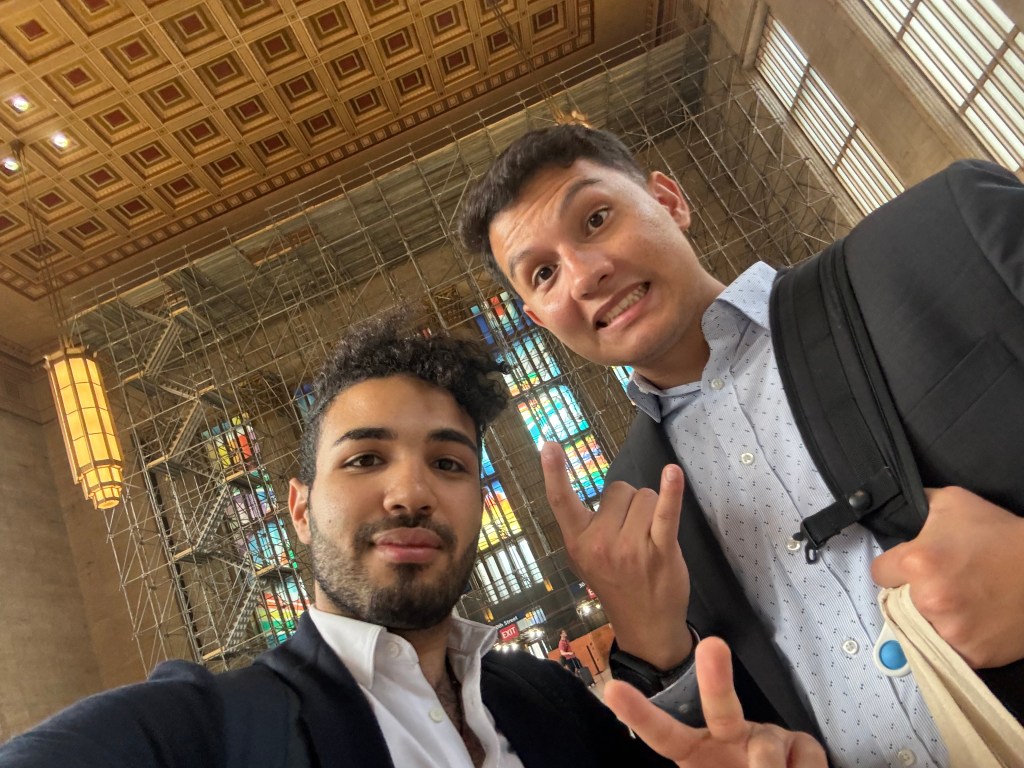
Unfortunately, this turned out to be a major black box. Even though I received a general qualification for a Foreign Affairs Officer position, my resume was ultimately tossed into a massive resume bank for the entire department. Meaning, if any office had any vacancy they wanted to fill, they could review a massive list and pull anyone off to interview and hire as desired. Basically, don’t hold your breath.
I discarded the thought and hope altogether and went about my life staffing around State, rolling my dice elsewhere with other contract jobs and policy positions. Then, much to my surprise, I received a wild email a few months later informing me that I was pulled off this list and invited to interview, and ultimately made an offer, to join the Bureau of Population, Refugees, and Migration in the J family. I’ll never forget the day I was in the flag room at the main entrance of the Department to call my mother and tell her,
“Ma, your son is going to be a U.S. Diplomat!”
After several other opportunities with contracting and civil service job applications fell through for odd reasons, the least predictable and lowest-chance gamble is the one that worked out. I’ll have to dedicate another blog post altogether to reflecting on what it’s been like to navigate the strangeness of Washington, D.C. because there is truly a milieu of lessons this city has taught me; and it’s only just begun. Similarly, I’ll dedicate a future post to what it’s been like to work as a diplomat and pose some of the complex questions that come with this line of work. It will surely take a lifetime to answer them, but hey! This journal is meant to document thoughts and questions that I’ve grappled with during the time of writing.
Speaking of ideas and questions, what’s my plan for academia now? I honestly want it more than ever now. The University of Chicago was kind enough to accept me again, after deferring and declining their last offer, to do an MA in Political Theory, so I might end up pursuing graduate study there in 2026. I want to give this FAO job two years before I leave DC and head towards graduate school. Having been granted a position in the federal government, I now have the ability to lay the foundation for walking between both worlds of academia and government. Words cannot express my gratitude and excitement for this opportunity. I want to do so with intention and care in pursuit of some fascinating questions. When I go back to school, I’ll now have the benefit of experience as a diplomat having worked directly on key international human rights challenges. Here are a few exciting questions that have guided my thinking this year that I hope to take back to graduate study for further academic inquiry:
- How has the idea of human rights facilitated the transformation of empire?
- With the many changes of 20th century internationalism, has the transformation of sovereignty become a problem for human rights theory?
- How does human rights theory suffer from a clash between law and politics?
- Is there a linkage of human rights theory to the construction of international laws, and their subsequent weaponization against the sovereignty of new states?
I thought I would end 2024 having completed half of my master’s degree at the University of Chicago. This year had very, very different plans in store, and I’m grateful for it. Thank you to everyone who’s stuck around for the wildness of this year, and cheers to all the excitement that awaits us in 2025!
This year’s defining songs:
- Purity Weeps, Invent Animate
- Aeons Torn, Inferi
- Just Pretend, Bad Omens
This year’s top study songs:
- Quantum Mechanics, Ludwig Goransson (Oppenheimer Soundtrack)
- Slytherin Common Room, J Scott Rakozy (Hogwarts Legacy Soundtrack)
- Camping, Johann Johannsson (The Theory of Everything Soundtrack)
 Oscar's Journal