
by osc.r

When I began college, I had with me a little blue UN badge granted to me from the NGO I worked for at the time, the Foundation for Post-Conflict Development. After classes on Thursdays of freshman year, I’d rush over to the train station, commute all the way up to the city, and attend First Committee meetings for the foundation. Afterwards, I would aimlessly walk around the HQ captivated by portraits of past Secretary Generals, quick-paced foreign dignitaries, and electrified by the thought that I was somehow part of this broader gathering of the world occurring throughout the period of the General Assembly. “International peace”, I wondered. What a curious thing.
This experience opened my eyes wide to what I wanted my future to look like. I wanted to be part of the conversations concerning the direction world governments are headed in the pursuit of global security. I wanted to represent my country on the world stage. Quickly following this internship, I became restless in my efforts to utilize college as a springboard into a career into foreign policy. I left my first college in search of a more rigorous research-oriented institution, and landed at Cornell. Here, I explored various clubs and courses to build a greater understanding of the role of human rights within multilateralism and U.S. foreign policy. Then, during the early Spring of my junior year, I received an email while sitting at the Temple of Zeus notifying me that I was selected for the 9th cohort of the U.S. Foreign Service Internship Program, USFSIP for short.
USFSIP is a two-summer experiential learning opportunity for undergraduates interested in a career with the Foreign Service. It is a remarkable program that affords college students an invaluable opportunity to explore the work of U.S. diplomats domestically the first summer at main state and the second summer overseas at an embassy. It is truly one of the greatest opportunities any college student interested in foreign policy could obtain to discern whether this field is for them or not. USFSIP was a highly influential and informative experience for me, so in this blog, I will take you along some reflections of my experiences both summers, and some key lessons I picked up about working in foreign policy.
Summer 2022: U.S. Mission to the UN, Washington (USUN/W)
The first summer, I was extremely excited to discover that I was assigned to the U.S. Mission to the United Nations, Washington office. I had begged the USFSIP folks to keep me with USUN because around that same time, I was accepted for the one summer DOS internship program over at USUN/New York in the Executive section. Between that and USFSIP the choice was obvious, but difficult nonetheless because my college dream was to work at USUN/New York.
[ // Quick aside \\ ] When I used to commute over to the UN freshman year, I would always walk by the USUN/New York and think to myself “I’m coming back for you.” The day I was offered a position in EXEC, I was in the middle of my constitutional law class Fall of my junior year. I tried so, so, so, so, so hard to contain my excitement. In my best effort to not disturb the class with a rapturous celebration, I impulsively made the meme below that captured what it was like for me to walk by USUN/New York back during my freshman year. Why, you ask?
¯\_(ツ)_/¯
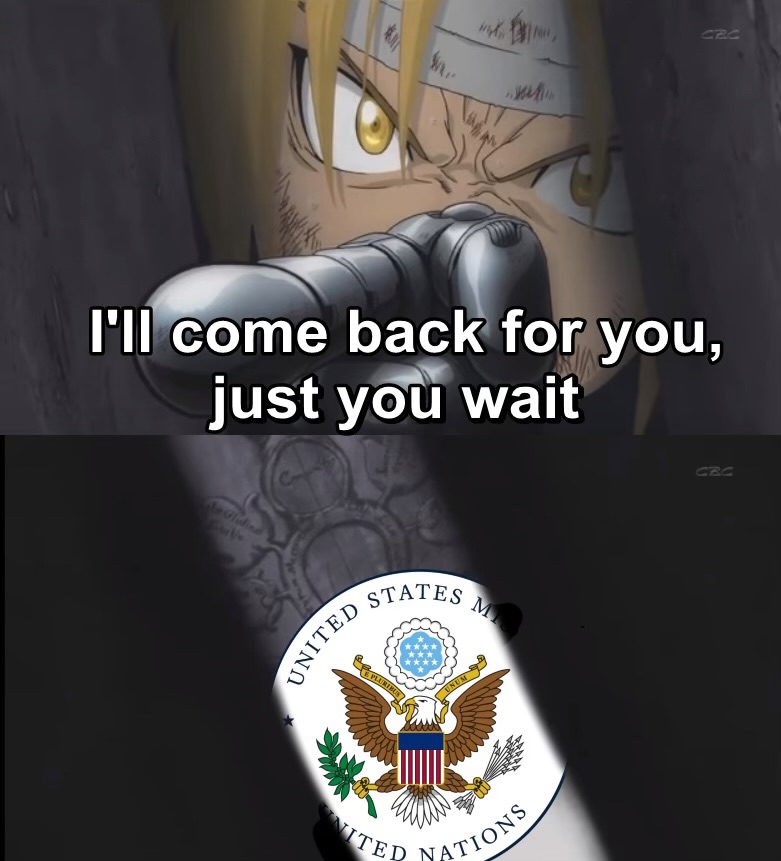
[ // Back to the Blog \\ ] My time at USUN/W was breathtaking. Having the chance to support the Senior Policy Advisors and the Deputy Ambassador in all of LTG’s cabinet responsibilities, I entered each day ready to dig in and learn as much as I could from the brilliant policymakers that stalked the “darkened and hallowed halls of USUN/W.” (The lighting in there was legitimately undesirable, but it’s still an exciting place to be.)
Lessons learned at USUN/W:
- International politics is all about pressure in increments.
From the senior policy advisors over at USUN/W, I learned that more often than not, the greatest wins in this field are found in seemingly small progress. Multilateral solutions to global issues are axiomatically complex in that competing interests, whether that be within one states’ own interagency process or between states, will always skew the response or resolution in question towards a particular direction. Altruism is never unaccompanied by self-interest or some overarching political motive, so when you operate within a field that is predicated on rules as such, progress will almost never appear linearly. This can be remarkably frustrating. Geopolitical rivalries have led to gridlock decisions, as we’ve seen in recent years within the UN Security Council. Diplomatic resolutions may be mired in precarity, where one states’ recalcitrance to international pleas may undermine months of intense negotiations involving numerous state and non-state actors.
Yet, successes come in what seems like small steps forward. To exemplify my point, let’s look at UNGA Resolution A/RES/ES-11/4, Territorial integrity of Ukraine: defending the principles of the Charter of the United Nations, adopted on April 7th, 2022. While this resolution didn’t help in ending the war, it greatly affected the direction of the political winds throughout the international community, building and affirming international consensus on this conflict. Consensus building, deserving of its own blog entirely, is extremely valuable for so many reasons, as it opens up many possibilities for future actions throughout the international community. That seemingly small pressure builds. Read the resolution here.
Funny enough, one of my most repeated songs that was recommended to me on Spotify that summer was Constance by Spiritbox, who’s chorus just happened to be:
“You pressure in increments, Like a slow-moving coup, memories dissident, when I am holding you”
- “Oscar, this isn’t House of Cards. Kindness is everything in this field.” – Everyone at USUN/W
This was a fun one to discover. From the outside, the media to me always portrayed the world of international politics with an air of intrigue, high political drama, and composed of dramatic, back-stabbing four faced politicians who bludgeon their way through the crowd to make their way to the top. I never accepted that perception as factual, but always wondered whether there was a kernel of truth to it. Coming into USUN/W, I quickly learned this was untrue. On multiple occasions, especially after colleagues would express frustration over challenges with other colleagues, folks at the office would turn to me and tell me to never forget the importance of kindness in this field. DC is a small place, and I really learned how costly “Underwood behavior” can be to one’s career and reputation. It was very refreshing to see diplomats emphasize the role of kindness in all facets of their work!
- Domestically, U.S. Foreign Policy is crafted and refined throughout the interagency process.
Coming into this summer, I always wondered where the ideas that eventually become U.S. foreign policy come from. So, one day I walked into one of the senior policy advisor’s offices and just abruptly asked, “Josh, where do the ideas come from!?” From then, the team was kind enough to rope me into some interagency conversations on key foreign policy objectives to witness and learn about how the government crafts its response to international crises and situations. This was extremely exciting to learn. Representatives from all relevant U.S. agencies to the topic at hand would gather in layers of rank. From advisors, to deputies, then to principals, each layer of the interagency process would mull through overarching objectives, resources available, and then filter out potential actions submitted by actors within this ring. Eventually, the most feasible options filter up through the layers by the time it reaches the principals, where a decision is then made on what action the U.S. will pursue.
Understanding this process is vital to learning how U.S. foreign policy is crafted, and what the range of possibilities truly are. After this process, I felt better-informed in my ability to understand and judge U.S. responses to international situations, as many criticisms often lack perspective on what responses/actions are actually feasible. USUN/W was extremely formative in this respect.
Highlights from USUN/W!
At USUN/W, the team works closely with the White House on Ambassador Thomas Greenfield’s UN responsibilities. When a new political counselor for the political team at USUN/New York was appointed, he came down to USUN/W to meet the multilateral team over at NSC. Luckily, the intern was invited to tag along to this conversation on how the U.S. could use its remaining time to more effectively advance the Biden Administration’s objectives at the UN. I still get goosebumps thinking about the conversation that occurred between USUN and NSC folks as they strategized on a greater vision. Sitting in the former Secretary of War’s office, listening to and absorbing the insights and points made by those in attendance, I think I finally saw for the first time, quite clearly, where I hope to end up someday.
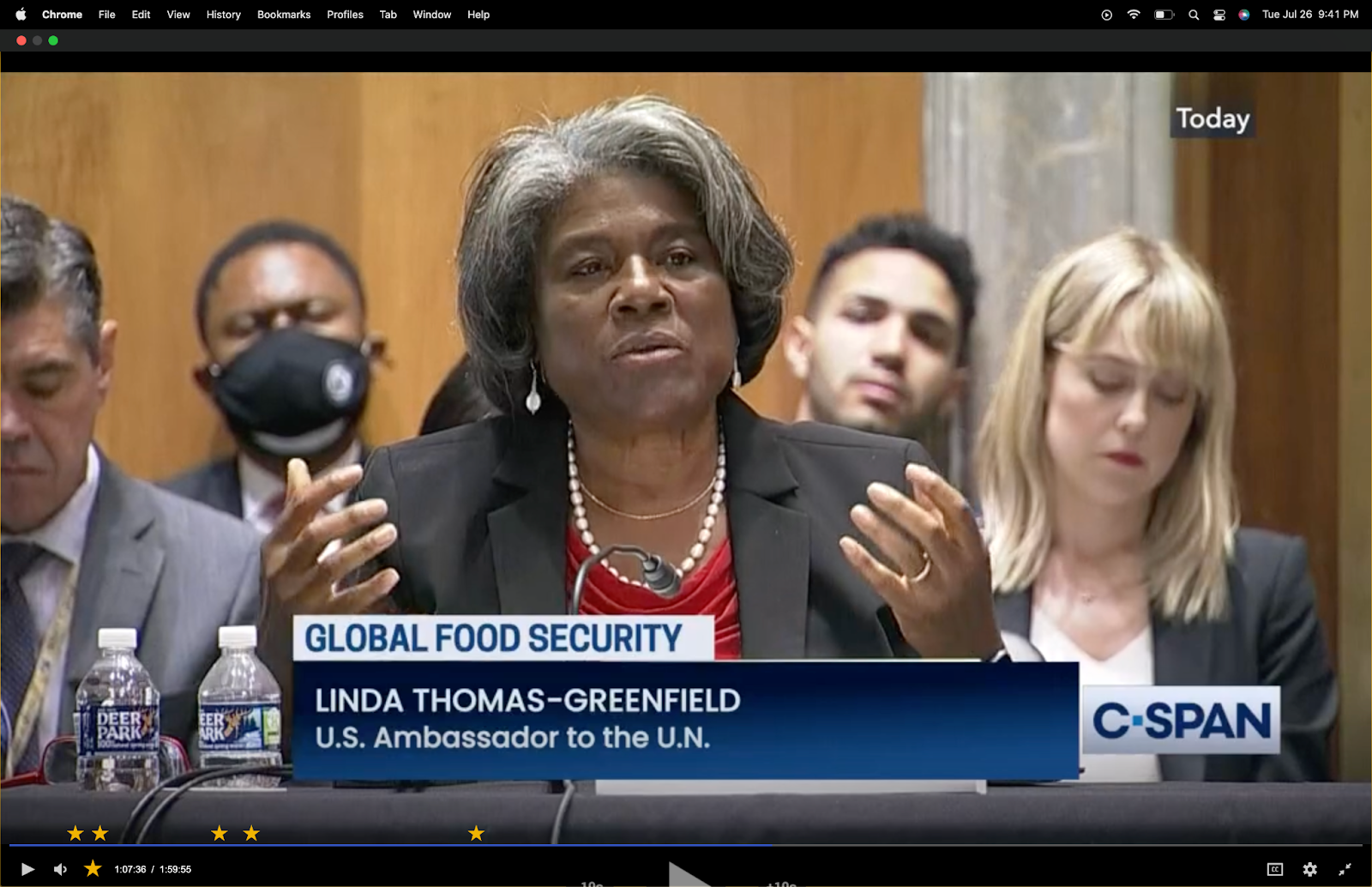
Another fun moment from the summer was having the opportunity to staff Ambassador Thomas-Greenfield’s hearing on food security at the Senate Committee on Foreign Relations, alongside USAID Director Samantha Power. Leading up to this, I worked with folks at USUN/NY to gather all the materials for her binder, put it together, and then was welcomed to attend the SCFR meeting with the team. This was another awesome opportunity to see how the USG communicates internally on our foreign policy priorities. Surprisingly, I came up on one of the camera angles on C-SPAN!
Finally, a highly memorable experience from this summer was walking into the office on the morning of July 27th and finding everyone surrounding the main TV in the office that read, “Major diplomatic breakthrough achieved” on the signing of the Black Sea Grain Initiative in Istanbul. That was the moment it hit me: “Ohhhh! That’s what those interagency policy committee meetings earlier this summer amounted to.”
Summer 2023: U.S. Mission to the UN Agencies in Rome (USUN/Rome)
While the domestic assignment gives you insight into the work of both the foreign and civil service at the State Department, the overseas assignment is clearly the summer intended to let interns taste not just the work of Foreign Service Officers, but to experience the lifestyle of what it feels like to live abroad. I graduated from Cornell in the final week of May 2023, and less than seven days afterwards, I was on a plane to Rome to work in the POL-ECON section of USUN/Rome.
Functionally, USUN/Rome covers all of the Rome-based UN Agencies such as the Food and Agriculture Organization (FAO), the World Food Program (WFP), the International Fund for Agricultural Development (IFAD), and other UN-affiliated agencies such as the International Centre for the Study of the Preservation and Restoration of Cultural Property (ICROM) and the International Development of Law Organization (IDLO). The purpose of USUN/Rome is to monitor these agencies and ensure that U.S. funding is being properly utilized, and advance U.S. foreign policy within these institutions. As you can see, the Rome-based agencies are largely food-related. Since Russia’s invasion of Ukraine, these institutions have become highly significant to U.S. foreign policy in combating the role of this conflict on food security. Even though these institutions are regarded as largely programmatic, they still end up becoming another forum for geopolitical competition. The U.S. invested over $8 billion USD in 2022 to combat food insecurity globally to the RBAs. This past summer, I was able to staff the U.S. delegation to the 42nd FAO Conference and get a nuanced insight into the primary players on global food security.
My main goals for this summer were twofold. First, I wanted to be able to pursue my own project that involved fact-finding, arranging my own bilaterals, and communicating my findings to Washington through a diplomatic cable. Second, I wanted to answer some pretty big questions I’ve wondered for a while: Do I want to pursue a career in the Foreign Service? Do I want to go back to academia to pick up all the legal and analytical tools I want before diving deep into my career? The following lessons navigated my thinking as I explored USUN/Rome throughout the oppressive heat of Italian summers.
- “Small” wins in multilateralism are not small.
The 43rd FAO conference occurred a little over a week before the renewal of the Black Sea Grain Initiative (BSGI for short) was set to occur. On the Friday of that conference, the U.S. co-hosted an event on the importance of the BSGI towards stabilizing food security globally. They brought in several industry experts such as FAO Chief Economist Maximo Torero to speak to the economic significance of this initiative, and what its dissolution would do to global food security. Charge d’Affaires Rodney Hunter closed out the event by saying quite plainly, “This isn’t about politics.” What stood out to me the most from this event was how in the days following, this event proved to be highly influential in consolidating international consensus against Russia’s brutal invasion of Ukraine. This was another affirming moment of that “pressure in increments” lesson, where we can see again how international consensus continues to reverberate across the international community.
This moment was really special because it showed me the unique role of a Foreign Service Officer within the broader scheme of the construction and implementation of U.S. foreign policy. Folks in DC rely heavily on the saviness of their diplomats overseas to collaborate creatively with foreign counterparts. Again, that consensus building is super valuable. This lesson was best exemplified to me through witnessing diplomatic orchestrations like this event, which ultimately served to harden that international consensus against Russia. With the experience of USUN/W, I had a greater appreciation of how this event had much greater consequences than it may have seemed like in the moment.
- The U.S. is vocal about its mistakes, and the rest of the world notices.
This one was unexpected. For those of us who have spent a majority of our lives in the States, at some point or another, we make the unfortunate mistake of taking our democracy for granted and sometimes lose sight of the value of fundamental rights like free speech. In conversations with section leaders and more senior FSOs, a lot of them expressed a sense of pride over how the U.S. compares to other countries in its ability to be self-critical. They told me that foreign counterparts would comment on this in appreciation, and they’ve found that this open ability to own our past mistakes has given them a range of interesting diplomatic abilities that other states with less open governments do not possess. This is an interesting point that I hope to explore further in my career and perhaps have an entire blog dedicated to at some point to really expound this in greater detail.
- If you’re sold on working in foreign policy, the decision to pursue the foreign service ultimately boils down to a question of lifestyle.
USFSIP helped me fall in love with the work of a diplomat. I experienced the work of the foreign and civil service within the department, and could really envision myself in many of the roles and places I briefly worked in. Yet, the question that pestered me before Rome was, do I want to pursue the foreign service right now? My summer domestically sold me on working in foreign policy, so it was up to Rome to determine if my path was to go foreign or civil. On this front, Rome certainly delivered. My conversations with many of the FSOs I met led me to understand that if I’m sold on working in foreign policy, my decision should honestly boil down to lifestyle. Do I like the lifestyle of an FSO? Do I enjoy the rotational nature of this career, moving around the world every 2-4 years? With all the benefits that come with the career, was I okay with nearly every facet of my life revolving around my career?
Thanks to the honesty and candor of many I spoke with, I came to realize that this lifestyle was not for me at this point of my life – and that’s okay!
Highlights from Rome
Aside from realizing this lifestyle wasn’t for me, I loved loved loved Rome. Never had I been able to experience the ancient world, so I took advantage of Rome’s rich history and spent tons of afternoons marveling at the ruins, museums, and endless works of art that decorate the city.
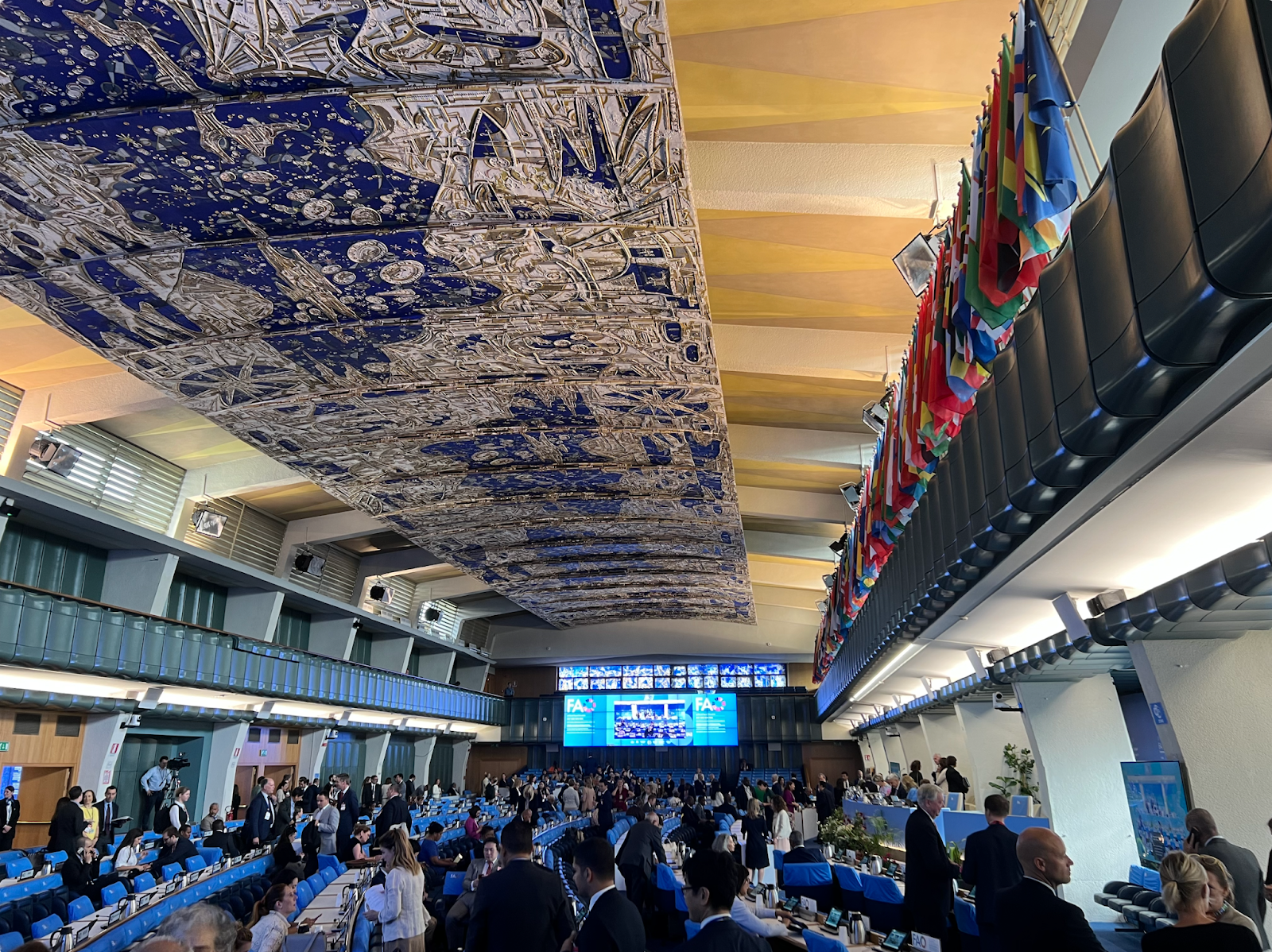

FAO conference and Isola di Ponza!
A fun highlight was my birthday, July 17th, when the Black Sea Grain Initiative was set to be voted on for renewal. Leading up to this day, I had asked the universe for one “simple” gift: Russia, please vote to continue this initiative! All I want for my birthday is international peace and global food security!
What did I get for my birthday instead? Russia’s withdrawal from the initiative and a cold…
USFSIP’s impact on my future
USFSIP was instrumental in my development as a foreign policy professional and taught me everything I needed to know in order to make an informed decision on whether this is right for me or not. Through these experiences, I learned that the Foreign Service is regarded as a generalist’s career and demands of its officers an extremely high degree of flexibility in being able to arrive at a new post, assume a new set of responsibility and challenges on topics of which they likely have next to no expertise, and then expected to deliver. The intensity and high demands of the foreign service is not inherently designed to develop expertise in any given topic, but rather to cultivate highly versatile and adaptive individuals who can perform at a very high level in any given environment. That is awesome.
I have the highest respect for these individuals and for this service, but upon reflection of my own values and desires for where I hope to arrive at, I’ve accepted that I’m not well suited to pursue the foreign service at this point in my life. I’m not ready to surrender my life to revolve around my career, and as much as I love the work of foreign policy, I’m also conscious of its all consuming nature in terms of one’s life. This field very easily takes over one’s life, and while this enables officers to make very meaningful contributions to the field, it also restricts other facets of one’s life in ways that I’m just not willing to give right now. I have many artistic and creative goals that I hope to meet this decade, and I can’t help but feel compelled towards the academy to investigate important questions about the origins and philosophical constructions of human rights. Besides, the common age of new foreign service officers is around 30. So, there really is no rush to this decision! I want to be able to fully commit to this field if and when the time comes.
Thank you so much to the team over at USFSIP for this powerful experience. For now, I’ll be running around USUN/New York as an Assistant to the General Assembly in the Political Section, knocking on the door of the civil service and the academy, curiously waiting to see which opens.
 Oscar's Journal